

Patellar Dislocation Surgery
Surgery for recurrent kneecap (patellar) dislocation and instability, from a fellowship-trained surgeon in Port St. Lucie and Palm Beach Gardens, FL.
Why does a kneecap keep dislocating?
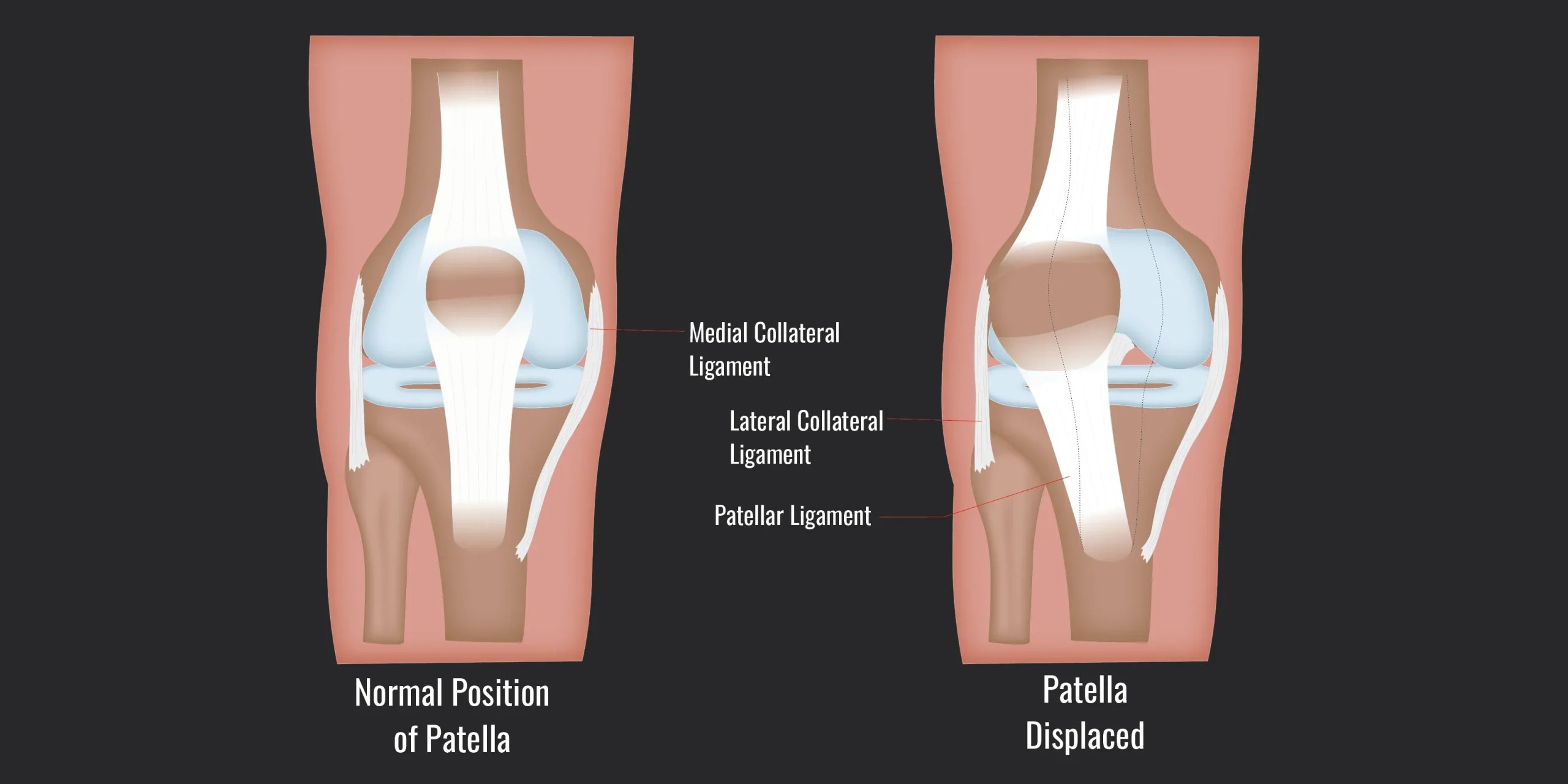
The kneecap runs in a shallow groove at the end of the thigh bone, held on line by the ligament on its inner side. Once that ligament has been stretched or torn, the kneecap can slip out again — and each time it does, it takes a little cartilage with it. Some people are simply built for it: a shallow groove, loose ligaments, or an alignment that pulls the kneecap outward. Others get there through one bad injury. Either way, repeated dislocations are not something to keep living with. Stabilisation usually means reconstructing that inner ligament, sometimes alongside realignment work, with anything already damaged addressed at the same time. Which combination you need comes out of the imaging, how the kneecap actually tracks, and how your leg is aligned — not from a standard operation applied to everyone. The rehabilitation afterwards is built around quadriceps strength and retraining how the kneecap moves.
What we treat
Recurrent Patellar Dislocation
A kneecap that has come out more than once, and now does it easily.
MPFL Ligament Injury
A stretched or torn MPFL — the ligament that holds the kneecap on line.
Patellar Maltracking
A kneecap that does not run true as the knee bends and straightens.
Patellofemoral Instability
Instability at the front of the knee, whether from how you are built or how you load it.
Lateral Patellar Tilt or Shift
A kneecap pulled steadily outward by imbalance in the soft tissue.
Cartilage Injury from Dislocation
Cartilage chipped or worn by dislocations that kept happening.
Post-Traumatic Patellar Instability
Instability dating from one specific injury — a fall, a tackle, an impact.
Adolescent / Young Athlete Knee Instability
Instability in a growing athlete, where the demands outpace the anatomy.
What stabilisation achieves
- A kneecap that stays where it belongs when you move
- Less pain and swelling, and the dislocations stop
- The kneecap tracking properly through its groove
- No further cartilage lost to the next episode
- Better muscle control around the joint, not just passive stability
- A markedly lower chance of it happening again
- A rehabilitation plan that progresses rather than plateaus
- Moving normally without bracing for the kneecap to go
- A return to sport decided by strength and control, not the calendar
- The joint preserved for the long run, not just this season
Come in, get a straight answer about what is wrong, and leave knowing what happens next.
Further reading: Kneecap (Patellar) Dislocation: When Is Surgery Needed?.
FAQ
Common Patient Questions
When the knee stays unstable despite rehabilitation, or when how you are built makes another dislocation close to inevitable.
It rebuilds the medial patellofemoral ligament — the tissue on the inner side of the knee whose job is holding the kneecap on line.
Yes. Strength, mobility and retraining how the kneecap tracks are what produce the result; the operation only makes them possible.
Rehabilitation starts straight away, and sport usually lands somewhere between four and six months depending on how you progress.
It substantially reduces the odds, and it protects the cartilage from the damage each dislocation causes.
Ordinary activity usually comes back within six to twelve weeks. Sport and high-impact work take longer — commonly four to six months, depending on healing and how the rehabilitation goes.
Generally after repeated dislocations, where there is real ligament or cartilage damage, or when the kneecap stays unstable despite non-surgical treatment.
Related
You may also be interested in
ACL Reconstruction
ACL Reconstruction →Meniscus Repair
Meniscus Repair →Knee Ligament Reconstructions
Knee Ligament Reconstructions →Where You’d Be Seen
Patellar dislocation surgery in Port St. Lucie & Palm Beach Gardens
This is offered at both locations — our orthopedic office in Port St. Lucie (1100 SW St. Lucie West Blvd., Ste. 105) and our orthopedic office in Palm Beach Gardens (11380 Prosperity Farms Rd, Ste 204). Patients travel in from Stuart, Jensen Beach, Fort Pierce, Jupiter, North Palm Beach and West Palm Beach — see every area we serve, or call 561-202-8886.