

Mako Total & Partial Knee Replacement
Robotic-arm assisted total and partial knee replacement for greater precision and faster recovery. MAKO-certified surgeon in Port St. Lucie and Palm Beach Gardens.
What does the robot actually do in a MAKO knee replacement?
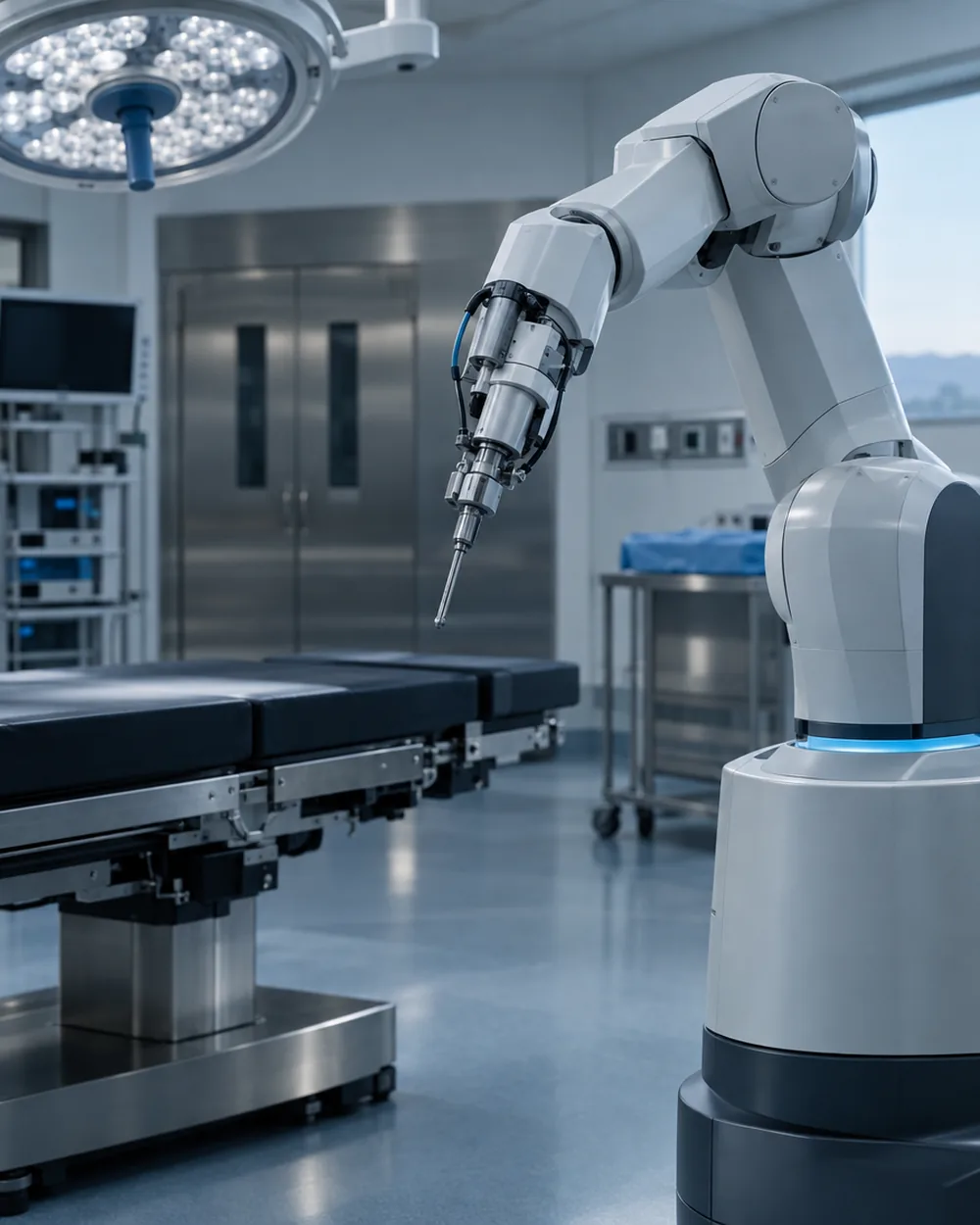
It does not operate. The surgeon does. What the MAKO™ system provides is a 3D model of your specific knee, built before the first incision, showing exactly where the cartilage has gone and where each component should sit. That plan then guides the implant into position to a tolerance a free hand cannot hold. Better alignment means the joint feels more like a knee and less like hardware, and it means less of the surrounding tissue has to be disturbed getting there. The same system handles a partial replacement or a total one — which of those you need depends on how much of the joint is actually worn, not on which is easier to plan for.
How does MAKO robotic knee replacement work?
“The first question patients ask me about MAKO is whether a robot is doing the operation. It is not. What the system does is take the part of knee replacement that has always depended on a surgeon’s judgement in the moment — exactly where each cut falls, exactly how the implant sits — and let me settle it in advance, against a 3D model of your own knee.” — Marc F. Matarazzo, MD
The plan comes first. A CT scan is turned into a three-dimensional model of your knee, and the operation is planned on that — not on an average knee, and not on a judgement made mid-procedure.
The arm holds me to it. I operate as I always have, with the MAKO robotic arm keeping the instrument inside the boundary we set. The damaged bone and cartilage come out; the healthy tissue around them stays.
Then the implant goes where the plan said. Alignment is what decides whether a replaced knee feels like a knee or like hardware — and it is also what decides how long the implant lasts.
Who is a MAKO knee replacement for?
Medial Compartment Osteoarthritis
Wear confined to the inner compartment — often a partial replacement candidate.
Lateral Compartment Osteoarthritis
Damage on the outer side of the joint.
Combined/Advanced Joint Degeneration
Arthritis across more than one compartment, where a total replacement is the honest answer.
Chronic Pain with Weight-Bearing Motion
Pain that arrives as soon as the knee takes your weight.
Limited Mobility Affecting Lifestyle
A knee that has started dictating what you can and cannot do.
Loss of Functional Knee Movement
Movement lost gradually enough that you stopped noticing until it mattered.
Joint Deformity from Long-Term Wear
Legs bowing or angling as years of uneven wear change the alignment.
Failure of Conservative Treatments
Pain that has outlasted therapy, injections and bracing.
Why we use it
- Components placed to a tolerance freehand technique cannot match
- Healthy bone and soft tissue kept wherever the damage allows
- Less disruption getting in, which shows up in the early recovery
- Smaller incisions, so less pain and less scarring
- A knee that moves like a knee rather than like an implant
- The plan is built from your anatomy before the day of surgery
- Better balance through the full arc of movement
- Alignment that should mean the implant wears more slowly
- Works for a partial or a total replacement alike
- Confidence back on your feet — standing, walking, stairs
- Function that is meant to last, not just feel better for a season
If only one part of your knee is worn, see partial knee replacement. For every option short of surgery as well, see knee arthritis treatment.
Come in, get a straight answer about what is wrong, and leave knowing what happens next.
FAQ
Common Patient Questions
The plan is built in 3D from your own anatomy and the arm holds the surgeon to it, which is what produces the alignment.
No. Dr. Matarazzo performs the operation throughout. The arm constrains the plan; it makes no decisions.
Most people are up and walking with support the same day.
If the arthritis sits in only one compartment, you may not need the whole joint replaced.
That is the point of planning it against your own anatomy rather than an average knee.
Yes — moderate to severe osteoarthritis is the usual indication, once conservative treatment has stopped holding the pain.
Yes. For a younger, active patient who genuinely needs the joint replaced, precision of placement matters more, not less — that implant has to last longer.
Related
You may also be interested in
Total Knee Replacement
Total Knee Replacement →MISHA Knee Implant
MISHA Knee Implant →Total Shoulder Replacement
Total Shoulder Replacement →Where You’d Be Seen
MAKO robotic knee replacement in Port St. Lucie & Palm Beach Gardens
This is offered at both locations — our orthopedic office in Port St. Lucie (1100 SW St. Lucie West Blvd., Ste. 105) and our orthopedic office in Palm Beach Gardens (11380 Prosperity Farms Rd, Ste 204). Patients travel in from Stuart, Jensen Beach, Fort Pierce, Jupiter, North Palm Beach and West Palm Beach — see every area we serve, or call 561-202-8886.